
How Long Do Dental Crowns Last? What Savannah Dentists Say in 2026
Most patients who walk into our Savannah practice asking about a crown have one question right behind it: how long do dental crowns last? The short answer is 10 to 15 years for most patients, with well-maintained crowns regularly lasting 20 or more. The longer answer depends on materials, the tooth’s location, your bite, and your daily habits.
At Beyond Exceptional Dentistry, we have placed thousands of crowns across every clinical scenario — from a single chipped molar to full-mouth rejuvenations. The patterns are consistent: crowns made from high-quality porcelain or zirconia, fitted with neuromuscular precision and supported by stable underlying tooth structure, last for decades. The crowns that fail early almost always trace back to bite forces, untreated grinding, or an outdated material choice.
Key Takeaways
Three things drive crown longevity more than any other factor: material choice, bite mechanics, and consistent home care. Below are the points we want every Savannah patient to leave a consultation knowing.
- Most modern crowns last 10 to 20 years. With premium materials and clean bite mechanics, 20 to 30 years is realistic for a typical Savannah patient.
- Temporary and permanent crowns live on completely different timelines. A temporary is a two-to-four-week placeholder; a permanent crown is restorative dentistry built for the long haul.
- No crown is truly forever, but neuromuscular fit gets the closest. Designing a crown to match how your jaw actually moves is the single biggest factor in crown durability.
How Long Do Dental Crowns Last?
For most adults, how long do dental crowns last comes down to three variables: the material, the cement bond, and the daily forces the crown faces. A porcelain-fused-to-metal crown typically lasts 10 to 15 years. All-ceramic and zirconia crowns, the materials we use most often at our Savannah office, regularly perform for 15 to 25 years under stable bite conditions.
Dental crown lifespan is heavily influenced by what is happening underneath the crown. If the underlying tooth develops decay at the margin, or the bone supporting an implant recedes, the crown can fail even though the crown itself is intact. Annual exams catch these issues early — crowns regularly outperform their averages when patients stay on a consistent maintenance schedule.
Crown durability also depends on what you ask it to do. Patients who grind their teeth at night without a night guard will burn through crowns 30 to 40 percent faster. The crown itself may not crack — instead, the bite force transfers into the bond or the underlying tooth, loosening the restoration over time.
How Long Do Temporary Dental Crowns Last?
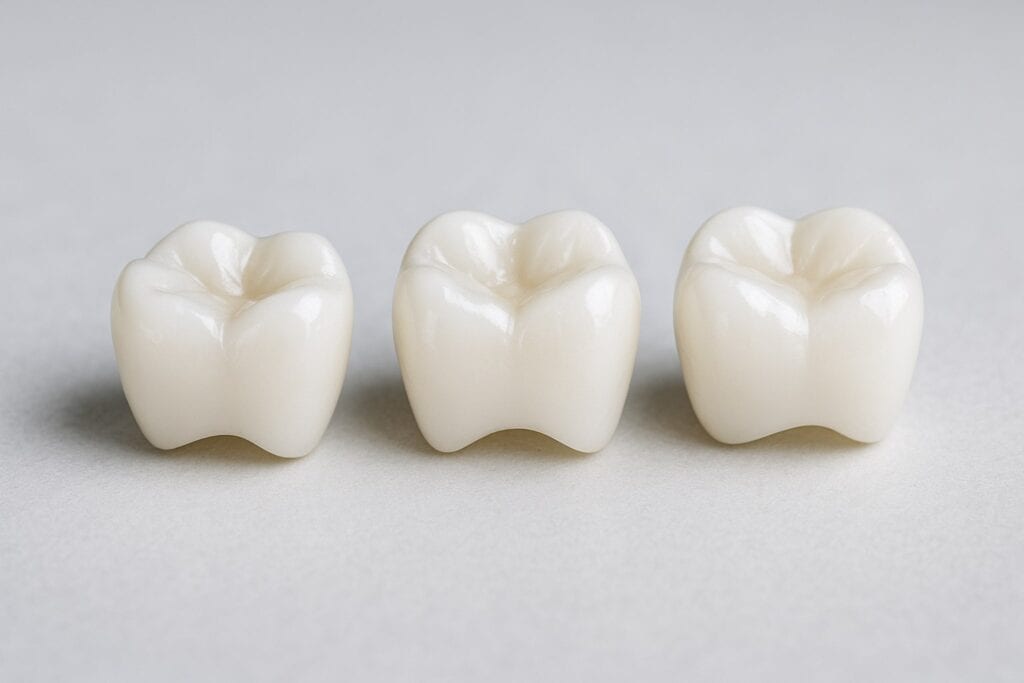
Temporary crowns protect the prepared tooth while the lab fabricates the permanent one. How long do temporary dental crowns last? Two to four weeks — the same window it takes to manufacture and seat your final crown. They are not built for the long term.
Temporary crown duration is intentionally short. The acrylic or composite materials are softer than permanent ceramics, designed to be removed easily so we can bond the permanent dental crown without damaging the underlying tooth. If a temporary stays in place longer than four weeks, the risk of margin leakage, sensitivity, or shifting increases.
Crown care during the temporary phase comes down to small habits:
- Avoid sticky foods like caramel and chewing gum that can pull the temporary off.
- Skip hard foods on that side — popcorn kernels and ice are the usual culprits.
- Floss gently, threading sideways through the contact instead of snapping down.
- Brush normally with a soft-bristled brush around the gum line.
If a temporary comes loose, call your dentist the same day — re-cementing takes minutes and prevents the prepared tooth from shifting.
How Long Does a Crown Last on a Front Tooth?
Front teeth carry different demands than molars. They are visible in every smile but handle less force. How long does a crown last front tooth? In our Savannah experience, 15 to 25 years for a properly bonded ceramic crown on a healthy underlying tooth.
Front tooth crown longevity gets a boost from two factors. Bite forces on front teeth are roughly 60 to 80 PSI compared to 150 to 200 PSI on molars — less stress on the cement bond and less fatigue on the crown. Front teeth are also easier to clean, since you can see what you are doing every time you brush.
The wildcard for front-tooth crown lifespan is aesthetic wear. Microscopic surface stains on a back-tooth crown are invisible. The same stains on a front-tooth crown become visible in every photo. Many patients replace front-tooth crowns long before they fail mechanically — they simply want the color to refresh.
Are Dental Crowns Permanent?
This is the question we hear in almost every consultation. Are dental crowns permanent? In the strict medical sense — no. In the practical sense — for many patients, yes. A well-made crown maintained with good home care can outlast the patient, but “permanent” is not a guarantee written into the procedure.
A permanent dental crown is engineered to be the final restoration. Unlike a temporary, it is bonded with permanent cement, contoured to your bite, and matched to surrounding teeth. When patients ask if their crown is for life, what they really want to know is whether they will redo this every few years. For a quality-built crown, the answer is no.
Crown restoration becomes necessary when one of three things happens:
- The underlying tooth develops decay at the margin.
- The bite shifts over time and creates new pressure points.
- The crown material shows visible wear, chipping, or color change.
We rarely replace crowns because the material fails. Far more often, patients have completed a smile makeover or full-mouth rejuvenation and want the crown to match new neighbors — the crown itself is still doing its job.
How Long Do Dental Implant Crowns Last?
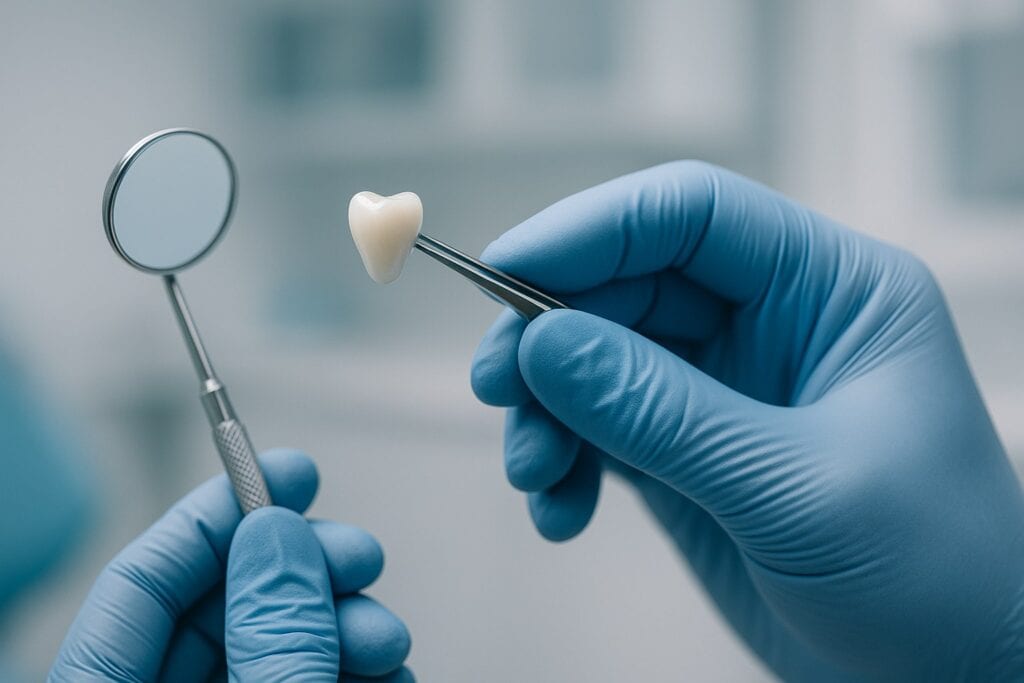
Dental implant crowns play by different rules. The crown sits on a titanium post fused directly into the jawbone, not on a natural tooth. How long do dental implant crowns last? The crown portion typically lasts 15 to 25 years, while the implant post itself can last a lifetime when the surrounding bone stays healthy.
Implant crown lifespan benefits from one major advantage over crowns on natural teeth: the underlying structure cannot get cavities. Titanium does not decay. Implant crowns rarely fail at the margin the way natural-tooth crowns sometimes do. When an implant crown does need to be replaced, the post stays in place — we simply swap out the crown.
Dental implant maintenance is similar to caring for a natural tooth, with one extra emphasis: gum health around the implant. Peri-implantitis — bone loss around the implant — is the most common cause of implant failure. Daily flossing, regular cleanings, and treating any early signs of inflammation keep the foundation strong. Learn more about dental implants at Beyond Exceptional Dentistry.
Do Crowns Last Longer Than Veneers?
Crowns and veneers solve different problems, but patients often weigh them as alternatives. Do crowns last longer than veneers? On average, yes — a crown lasts 10 to 25 years while a veneer typically lasts 10 to 20 years. But the comparison is more nuanced than the numbers suggest.
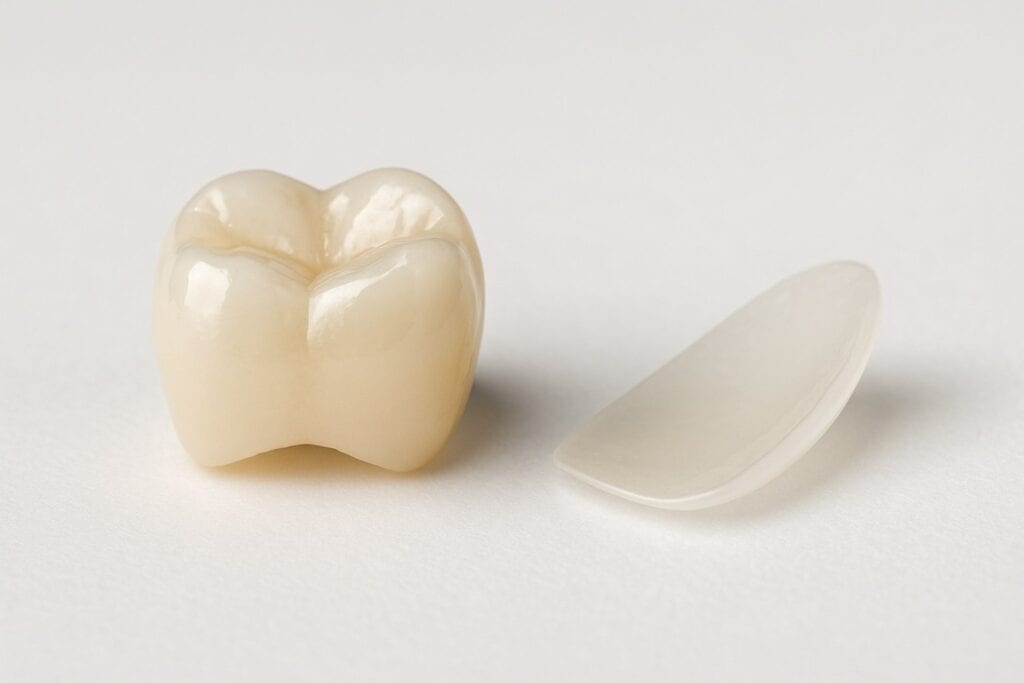
A dental crown vs veneer choice depends on how much tooth structure remains. A crown covers the entire tooth and is the right call when the tooth has cracked, had a root canal, or lost substantial structure. A porcelain veneer covers only the front surface — the right call when the tooth is structurally sound but cosmetically imperfect.
Veneer longevity has improved significantly with modern ceramics. With careful bite design and a night guard for patients who grind, we see veneers regularly lasting 15-plus years at our Savannah practice. The honest answer: if your tooth needs structural protection, you need a crown. If your tooth is healthy and you want a cosmetic upgrade, choose a veneer. Lifespan should be a secondary consideration — function and goals come first.
FAQ
For most patients, a properly placed modern crown lasts 10 to 20 years. Premium materials like zirconia, combined with a stable bite and good home care, can push that to 25 to 30 years.
Yes, though it is rare with permanent crowns. If it happens, save the crown, avoid chewing on that side, and call your dentist the same day. Most loose crowns can be re-bonded if the underlying tooth is healthy.
Most dental insurance plans cover replacement after a five- to eight-year waiting period, provided the replacement is medically necessary. Cosmetic replacement is usually not covered.
No — porcelain and ceramic crowns do not respond to whitening treatments. If the color no longer matches your surrounding teeth, replacement is the only option. This is why many patients schedule whitening before crown placement.
Conclusion
How long do dental crowns last comes down to materials, bite mechanics, and consistent home care — with modern crowns regularly performing 10 to 25 years and premium ceramic crowns lasting longer. How long do temporary dental crowns last is a much shorter story: two to four weeks while your permanent crown is being made. If you are planning a dental crown in Savannah, schedule a consultation with our team — we will walk through the materials, longevity expectations, and bite considerations for your case.